
Thursday, 21st September 2023 at 6pm.
Tickets available for attendance
- in person at the Poly, Falmouth (ticket cost covers Poly room hire)
- online via Eventbrite (free tickets)
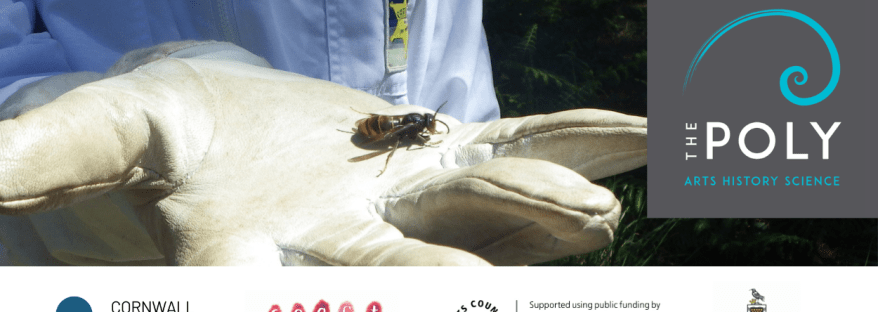
Dr Thomas O’Shea-Wheller tells us how the invasive hornet disrupts honey bee colonies and how we can prevent it becoming established in the UK.
The invasive Asian hornet (Vespa velutina nigrithorax) has spread rapidly across parts of Europe and East Asia in the last two decades, with concordant effects upon beekeeping, agriculture, and biodiversity. The hornets are effective predators of a variety of native pollinators, and will actively target colonies of honey bees (Apis mellifera), leading to disruption of the foraging process. While there have been concerted attempts to control the expanding invasion front, these have been largely unsuccessful, due to the difficulty of detecting initial incursions into new regions. In this talk, Thomas will outline recent research aiming to address this issue, and summarise the ongoing efforts to prevent the hornets’ establishment in the UK. Additionally, Thomas will summarise how the public can assist in these efforts, and hence contribute to the UK’s pre-emptive exclusion strategy.

Thomas is a Research Fellow based at the University of Exeter’s Environment and Sustainability Institute (ESI). His work investigates the rules underpinning collective behaviour, colony functioning, and self-organisation within social insects. A central aim of this research is to leverage complex systems—specifically those found in insect colonies—to solve real-world challenges in biology. To achieve this, he utilises ants, bees, hornets, and termites as models to explore network dynamics, interindividual heterogeneity, and social immunity. Thomas’s current research includes projects pertaining to honey bee health and epidemiology, automated tracking of bumble bee colonies, and the detection of invasive species via artificial intelligence.
 Cornwall Science Community